blog-logo
  • Home
  • WP Plugins
    WP PluginsShow More
    SEOPress Pro Review 2026: Features, Pricing and Verdict
    21 Min Read
    Most WordPress form plugins stop at the point of submission: the entry lands in the database, an email goes out, and everything after that is your problem. This Formidable Forms Pro review looks at a builder that treats submitted data as something you can act on — collecting payments, triggering automated workflows, and publishing entries back to the front end through Views. For anyone who has outgrown a basic contact form and started sketching directories, calculators, or client-facing dashboards, that distinction matters more than field types do. The question is whether an annual license justifies itself for site owners whose forms need to do real work after the submit button. Quick Verdict Formidable Forms suits freelancers, agencies, and business owners building data-driven forms — payment flows, application systems, front-end listings — on WordPress. Anyone who only needs a styled contact form will find the license hard to justify, and the plugin has no use outside WordPress. Pros Views display submitted entry data on the front end, turning forms into simple web applications rather than one-way capture points Payment collection through Stripe, PayPal, Square, and Authorize.net covers most common checkout setups CRM and automation integrations include Salesforce, Zapier, Google Sheets, HubSpot, and Mailchimp Business and Elite licenses cover unlimited sites, including client sites — practical for agencies juggling multiple builds Over 100 form templates give you a starting point instead of a blank canvas Layered spam protection built in via reCAPTCHA, honeypot, and Akismet Pro zip uploads directly through the WordPress plugin uploader with no extraction step Cons User registration is limited to certain plans and requires a separate add-on rather than working out of the box Single-site and three-site limits on Basic and Plus push multi-site owners toward the pricier Business or Elite tiers 👉 See Formidable Forms pricing Core Features The formidable-pro-6.34.zip file installs directly in WordPress via Plugins → Add New Plugin → Upload Plugin, without extracting it first — a small detail, but one that saves a step for anyone used to unzipping archives before upload. Views: Displaying Submitted Entries on the Front End Views are the feature that separates Formidable Forms from the average contact form plugin. Instead of entry data sitting in the WordPress admin waiting for someone to export it, Views pull submitted entries back out and render them on the front end — as directories, listings, tables, profile pages, or whatever layout the data suits. That changes what a form is for. A submission stops being a message you reply to and becomes content that populates a page. Job boards, member directories, event calendars, review listings, and internal dashboards all become achievable without a separate directory plugin or custom post type work. For anyone considering the Pro license specifically, this is usually the reason. Views are what make the "front-end web applications" claim more than marketing language. Form Builder for Simple Forms and Full Applications The builder handles the ordinary case — a contact form, a quote request, a newsletter signup — and then keeps going. The same interface builds multi-step forms and calculation-driven applications, so you are not learning a second tool when a project grows past a name-and-email field. The practical benefit is consistency across a portfolio. A freelancer building a five-field contact form on one site and a mortgage calculator on another works inside the same builder both times, which shortens the second build considerably. Payment Collection Payments run through Stripe, PayPal, Square, and Authorize.net. Having four processors available matters more than it sounds: merchant account availability varies by country and by business type, and being locked to a single gateway is a common reason form plugins get replaced mid-project. This covers the transactions that do not belong in a full store — donations, deposits, booking fees, application charges, invoice payments. Rather than installing WooCommerce to take a single fee, you attach payment collection to a form you were building anyway. A WooCommerce integration is available separately for sites that do run a store. Workflow Automation Automation ties what happens after submission to conditions you set, so form data triggers actions instead of just landing in a database table. Combined with Views, it is the second half of the application-building story — data comes in, actions fire, results display. For a business owner, this is the difference between checking an inbox and having submissions route themselves. Approval steps, conditional notifications, and follow-up actions run without anyone opening the WordPress dashboard. Integrations With CRMs, Marketing Tools, and Automation Platforms The integration list covers Salesforce, HubSpot, Mailchimp, Zapier, Google Sheets, ChatGPT, and Webhooks alongside the payment gateways, plus WooCommerce and ACF on the WordPress side. Two of those deserve attention. Zapier and Webhooks together mean that anything not on the native list is still reachable, and Webhooks in particular gives developers a direct route into custom endpoints. Google Sheets suits teams who want submissions in a spreadsheet their non-technical colleagues already use, without granting WordPress admin access. 100+ Form Templates The template library ships with over 100 prebuilt forms. For agencies handling repetitive client requests — contact, quote, registration, application, feedback — starting from a template and editing fields is faster than building from an empty canvas each time. Templates also serve as a reference for how the builder handles more complex structures, which helps when you are moving from simple forms toward calculation or multi-page setups. Layered Spam Protection Three spam defenses are built into the plugin's settings: reCAPTCHA, a honeypot field, and Akismet. They work at different points — the honeypot catches naive bots silently, reCAPTCHA challenges suspicious sessions, and Akismet checks submission content against a shared spam database. Because all three are configured inside Formidable Forms rather than bolted on through separate plugins, you can layer them according to how aggressive a given form needs to be. A newsletter signup and a public job application do not need the same level of friction. User Registration Forms can create WordPress user accounts, which turns a signup form into the front door of a membership area, client portal, or community site. Registration is not part of the base install — it depends on the user registration add-on and is limited to certain plans, so confirm plan eligibility before committing to a build that relies on it. Paired with Views, registration supports a common pattern: users sign up, submit entries, and see their own submissions displayed back to them on the front end. Installation and Setup Setup is quick. Tested on WordPress 6.5 with PHP 8.4, installation and basic configuration took about two minutes from upload to a working form. Install the free Formidable Forms plugin first. The free core plugin is distributed through the WordPress.org plugin directory. Search for it under Plugins → Add New Plugin, install it, and activate it. The Pro plugin is an extension, not a replacement — the free core plugin must remain installed and active for Pro to function. Deactivating it will break the Pro features. Purchase a Pro license. Four tiers are sold: Basic, Plus, Business, and Elite. Download the Pro plugin ZIP from your account after purchase. Upload the Pro ZIP through WordPress. Go to Plugins → Add New Plugin → Upload Plugin, choose the ZIP file, and install it. The archive installs directly — there is no need to extract it or dig for a nested plugin folder inside it first. Activate the Pro plugin. Both plugins now appear in your plugin list, and the Pro features become available inside the Formidable Forms admin screens. Build your first form, starting from a template rather than a blank canvas. Turn on spam protection. reCAPTCHA, honeypot, and Akismet are all supported and configured through the plugin's settings. Connect the services you need. Payment processors and third-party tools are set up per form or through the global settings, depending on the integration. Add the user registration add-on if your plan includes it. The vendor maintains a Docs & Support area and a community resource for anything beyond the basics. Compatibility and Requirements Requirement Detail WordPress version 6.3 or higher PHP version 7.4 or higher License GPL The vendor is blunt about the platform requirement: "Formidable Forms is a WordPress Plugin. In order to use Formidable Forms, you must have a WordPress site. That's all." There is no standalone, hosted, or non-WordPress version — if your site runs on Squarespace, Webflow, or a static generator, this is not the tool for you. For a live, public-facing site, pair a currently supported PHP version with the current stable WordPress release rather than sitting at the stated minimums. Unsupported PHP branches stop receiving security patches, and a form plugin handling payments and personal data is the last place to accept that risk. On the integration side, the plugin connects with Stripe, PayPal, Square, and Authorize.net for payments, plus Salesforce, HubSpot, Mailchimp, Zapier, ChatGPT, Google Sheets, Webhooks, WooCommerce, and ACF. Formidable Forms Pricing Formidable Forms runs on a freemium model. The free core plugin, distributed through the WordPress.org plugin directory and often referred to as Formidable Forms Lite, is a drag-and-drop form builder used on hundreds of thousands of active sites. It handles standard form building on its own, and it also acts as the foundation for the paid product. The Pro version is sold as an annual license across four tiers. Plan Price Sites Basic $79/year 1 site Plus $199/year Up to 3 sites Business $399/year Unlimited sites, including client sites Elite $599/year Unlimited sites, including client sites All four tiers are currently listed at 50% off those regular rates — Basic at $39.50/year, Plus at $99.50/year, Business at $199.50/year, and Elite at $299.50/year. Discounting at this depth is a familiar pattern in the WordPress form builder market, so treat the promotional figure as the price you are likely to see rather than the price the plugin is nominally worth. Paid plans are GPL licensed and include one year of updates and support. A 14-day money-back guarantee applies to purchases. For agencies and freelancers, the Business and Elite tiers are the ones worth weighing. Both cover unlimited sites, client sites included, which removes the per-project license math that eats into small builds. Alternatively, a license can be purchased per client site if you would rather bill each project separately. Formidable Forms also runs an affiliate program paying 20% commission. Feature availability differs by tier. Check the current plan comparison at formidableforms.com before buying so the tier you choose covers the integrations and add-ons your build actually needs. 👉 Get Formidable Forms at the best available price Alternatives to Formidable Forms Formidable Forms sits at the heavier end of the WordPress form builder market, where the job extends past capturing a message into payments, automation, and displaying submitted entries on the front end through Views. The alternatives below are the names most site owners weigh against it, and they differ mainly in how far past basic form capture they go. Product Key Difference Best For Price Tier Formidable Forms Views display submitted entry data on the front end, alongside payments, workflow automation, and unlimited-site licensing on the Business and Elite tiers Freelancers and agencies building data-driven forms and front-end applications across multiple sites Freemium, with paid annual Pro licenses WPForms Beginner-oriented drag-and-drop builder with a template-first onboarding flow Site owners who want conventional contact, survey, and order forms with minimal setup Freemium, with paid annual licenses Gravity Forms Long-established developer-focused builder with a large third-party add-on ecosystem Developers who want extensive hooks and a wide catalog of extensions Paid, subscription-based Fluent Forms Positioned around a lightweight footprint and fast form rendering Sites where keeping plugin overhead low is a priority Freemium, with paid licenses Ninja Forms Modular architecture where features are added as individual extensions Users who prefer to pay only for the specific functions they need Freemium, with paid extensions Contact Form 7 Minimal, markup-driven form handling with no built-in visual builder Simple contact forms on sites that need nothing more Free Competitor data is sourced from publicly available information as of 2026 and may have changed. The right pick comes down to what you are actually building. A single contact form does not justify an annual license, but if you need front-end entry display, payment gateways, and CRM handoff on several client sites, the comparison narrows quickly. Frequently Asked Questions Is Formidable Forms free or do you need the Pro version? A free version exists and is distributed through the WordPress.org plugin directory as a drag-and-drop form builder. The Pro version is sold as a paid annual license and adds the features covered above, including Views, payment collection, and the wider integration set. Does Formidable Forms require the free plugin to be installed? Yes. The free Formidable Forms core plugin must remain installed and active for the Pro plugin to function — Pro runs as an extension of the core plugin rather than a standalone replacement. How much does Formidable Forms cost per year? There are four annual tiers: Basic at $79/year, Plus at $199/year, Business at $399/year, and Elite at $599/year. All four are currently listed at 50% off those regular prices, so the promotional figures are $39.50, $99.50, $199.50, and $299.50 respectively. How many sites can I use one Formidable Forms license on? Basic covers a single website and Plus covers up to three sites. Business and Elite licenses can be used on unlimited sites, including client sites, or a license can instead be purchased per client site. What are Formidable Forms Views used for? Views display submitted entry data on the front end of your site, so form submissions become readable content rather than data locked in the admin area. That is what allows the plugin to power directories, listings, and simple front-end web applications instead of just capturing and storing entries. Can Formidable Forms collect payments with Stripe or PayPal? Yes. Payment collection is a core capability, with integrations for Stripe, PayPal, Square, and Authorize.net, alongside WooCommerce for store-based workflows. What are the WordPress and PHP requirements for Formidable Forms? Recent versions require WordPress 6.3 or higher and PHP 7.4 or higher. Beyond that, a WordPress site is the only requirement — the plugin does not work on non-WordPress platforms. We installed it on WordPress 6.5 with PHP 8.4 without issues. Does Formidable Forms offer a refund or money-back guarantee? Yes, a 14-day money-back guarantee applies to purchases. That gives you a short window to test the Pro feature set on a real site before the sale becomes final. Is Formidable Forms GPL licensed? Yes, the Pro plugin is distributed under the GNU General Public License. Paid plans include one year of updates and support, which means continued access to updates depends on renewing the license. Download & Pricing Options 🆓 Free Version 👉 Download the Free Version of Formidable Forms 💎 Get Formidable Forms (Best Available Price) 👉 Check Current Pricing for Formidable Forms Pricing and availability may change — use the link above for current rates. Buying Formidable Forms Pro outright is not the only route. See our best GPL site for WordPress comparison for how ten GPL vendors differ on file integrity, update speed and licence keys.
    Formidable Forms Pro Review 2026: Features, Pricing, Verdict
    19 Min Read
    UpdraftPlus Premium Review 2026: Is the Upgrade Worth It?
    23 Min Read
    FluentCRM Pro Review 2026: Features, Pricing and Verdict
    22 Min Read
    PixelYourSite PRO Review 2026: Is This Tracking Plugin Worth It?
    17 Min Read
  • WP Themes
    WP ThemesShow More
    Loco Translate Pro + Pro Addons Review 2026: Features and Setup
    12 Min Read
    Order Delivery Date Pro Review (2026)
    14 Min Read
    MainWP Sucuri Extension Review 2026: Free Malware Scanning?
    13 Min Read
    TaxoPress Review 2026: Is This WordPress Taxonomy Plugin Worth It?
    15 Min Read
    Social Snap Review 2026: Is This WordPress Social Plugin Worth It?
    15 Min Read
  • Security
  • SEO
  • Woo
  • Contact
GPL Store
PureGPL BlogPureGPL Blog
Font ResizerAa
Search
  • Home
  • WP Plugins
  • WP Themes
  • Security
  • SEO
  • Woo
  • Contact
Follow US
Copyright © 2014-2023 Ruby Theme Ltd. All Rights Reserved.
Web GuidesWordPress Themes

W3 Total Cache Review 2026: Is It Still Worth Using?

Shubhankar
By Shubhankar
Last updated: August 25, 2026
18 Min Read
SHARE

WordPress performance optimization has a complexity problem. Most caching plugins either oversimplify the process or bury site owners in settings they don’t understand — and the wrong configuration can slow a site down rather than speed it up. This W3 Total Cache review examines whether its unusually deep feature set is a strength worth mastering or a liability that pushes most users toward simpler alternatives.

Contents
Quick VerdictCore FeaturesPage CacheMinify (HTML, CSS, and JavaScript)Database Cache and Object CacheBrowser CacheCDN IntegrationHTTP/2 PushLazy Load Images and WebP ConversionAMP and Reverse Proxy SupportScript and Emoji ControlsPageSpeed Tests and Dashboard WidgetDeveloper and Multisite ToolsInstallation and SetupCompatibility and RequirementsW3 Total Cache PricingPro Pricing TiersAlternatives to W3 Total CacheFrequently Asked QuestionsIs W3 Total Cache free?How much does W3 Total Cache Pro cost?W3 Total Cache vs WP Rocket: which is better?Does W3 Total Cache work on shared hosting?Does W3 Total Cache support CDN integration?Is there a money-back guarantee for W3 Total Cache Pro?Download & Pricing Options🆓 Free Version💎 Get W3 Total Cache (Best Available Price)

W3 Total Cache demo homepage or its most recognisable screen


The real question is whether the free tier’s breadth and the Pro upgrade’s added value justify the learning curve when polished competitors exist.

Quick Verdict

W3 Total Cache is the right choice for developers and technically confident site owners who want granular control over every layer of WordPress caching without paying for a premium plugin. Those who want a fast, low-configuration setup will find the complexity frustrating and should look at alternatives.

Pros

  • Generous free tier covers page cache, minification, CDN integration, object cache, database cache, and more
  • Works across shared hosting and dedicated or clustered server environments
  • Over 1 million sites use it, with a 4.4/5 rating from more than 5,000 reviews
  • Multi-site license tiers include a free Plugin Configuration service, reducing setup burden
  • 30-day money-back guarantee on all Pro plans

Cons

  • Configuration depth is substantially higher than competitors like WP Rocket, requiring real technical knowledge to get right

👉 See W3 Total Cache pricing

Core Features

Page Cache

Page cache is the foundation of what W3 Total Cache does: it stores fully rendered HTML versions of WordPress pages so the server skips PHP execution and database queries on repeat visits. The plugin extends this with automatic page cache priming, which pre-generates cached versions of pages before a visitor requests them — rather than waiting for the first real visitor to trigger the cache.

Preview mode lets you test a new cache configuration against your live site before committing to it. That’s a practical safeguard when you’re adjusting cache rules on a site that can’t afford downtime or visual regressions.

Minify (HTML, CSS, and JavaScript)

Minification strips whitespace, comments, and redundant characters from HTML, CSS, and JavaScript files, reducing their transfer size. W3 Total Cache handles all three file types within a single plugin, so there’s no need to layer a separate minification tool on top of a caching solution.

The practical effect is fewer bytes sent over the wire on every page load. For sites carrying multiple third-party scripts or large stylesheets, this reduction compounds across every visitor session.

Database Cache and Object Cache

Database cache stores the results of MySQL queries so repeated identical queries return from cache rather than hitting the database again. Object cache works at the WordPress object layer, persisting the results of expensive PHP operations — such as complex WP_Query calls — across requests.

Together, these two caches reduce the computational load on the server, which matters most on shared hosting where database resources are constrained and on high-traffic sites where query volume can spike unpredictably.

Browser Cache

Browser cache instructs visitors’ browsers to store static assets locally — images, scripts, stylesheets — so subsequent page views load those files from the user’s own machine rather than re-downloading them. W3 Total Cache manages the HTTP headers that control this behavior.

The result is faster repeat visits for returning users and a measurable reduction in outbound requests from your server.

CDN Integration

CDN asset caching is part of the core feature set, routing static files through a content delivery network to serve them from edge locations closer to each visitor. This is available in the free tier, not gated behind a Pro upgrade.

For sites with a geographically distributed audience, offloading static assets to a CDN reduces latency and takes bandwidth pressure off the origin server.

HTTP/2 Push

HTTP/2 push allows the server to proactively send critical assets — such as CSS or fonts — to the browser before it has parsed the HTML and discovered it needs them. W3 Total Cache supports this natively, without requiring a separate plugin or server-level configuration outside the plugin itself.

Sites already running on an HTTP/2-capable host can activate this to reduce the round-trip delay that normally occurs between HTML delivery and asset discovery.

Lazy Load Images and WebP Conversion

Lazy loading defers the loading of off-screen images until the user scrolls toward them, cutting the initial page weight on image-heavy pages. WebP conversion automatically serves images in the WebP format to browsers that support it, which typically produces smaller file sizes than JPEG or PNG equivalents.

On the free tier, WebP conversion is rate-limited to 10 conversions per hour and 100 per month — sites with large image libraries will hit that ceiling quickly.

AMP and Reverse Proxy Support

W3 Total Cache includes AMP support, allowing its caching rules to apply correctly to Accelerated Mobile Pages without breaking the AMP document structure. Reverse proxy support lets the plugin work within server architectures where a proxy layer sits in front of WordPress — a common setup on dedicated or clustered hosting environments.

Both features address infrastructure scenarios that simpler caching plugins often ignore, which is part of why W3 Total Cache targets a range from shared hosting to dedicated server clusters.

Script and Emoji Controls

Three lightweight but frequently useful toggles ship alongside the main caching features: disabling the WordPress emoji script, disabling the wp-embed script, and disabling jquery-migrate on the front end. Each removes a default WordPress asset that many sites don’t need.

Individually, the savings are small. Across a high-traffic site, eliminating unnecessary HTTP requests on every page load adds up — and doing it through a single plugin avoids the need for custom code in functions.php.

PageSpeed Tests and Dashboard Widget

A PageSpeed widget sits in the WordPress dashboard, surfacing performance scores without requiring a separate browser tab or third-party tool. The plugin also includes PageSpeed testing functionality for running assessments directly from within WordPress.

Having performance data visible inside the admin panel makes it easier to spot regressions after a theme update or new plugin install, rather than discovering a slowdown through user complaints.

Developer and Multisite Tools

WP-CLI support means cache operations — flushing, priming, configuring — can be scripted and run from the command line, which matters for developers managing deployments or automating maintenance tasks. Import and export of settings allows a working configuration to be transferred between installations without manual re-entry.

File locking, debug tools, and user agent, referrer, and cookie groups round out the toolkit for more complex setups. The grouping controls let you serve different cached versions to different visitor segments — useful for sites that vary content by device type, traffic source, or session state. WPML support and Genesis Framework optimizations address two common WordPress stack combinations where generic caching configurations can cause conflicts.

Installation and Setup
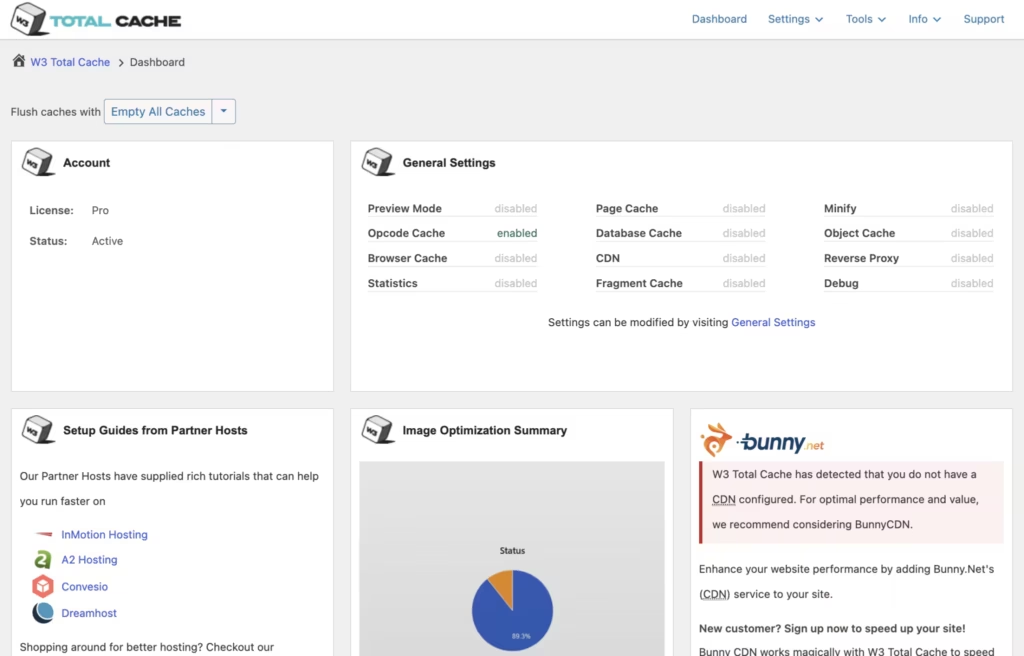
W3 Total Cache's setup wizard, demo importer, or settings panel


The free version of W3 Total Cache can be obtained from boldgrid.com/w3-total-cache. To install it, download the plugin file from that site, then go to Plugins > Add New > Upload Plugin in your WordPress admin panel and upload the downloaded file.

  1. After uploading, click Activate to enable the plugin.
  2. Navigate to Performance in the left-hand admin menu — this is where all W3 Total Cache settings live.
  3. Work through the setup wizard or configure each caching module manually: Page Cache, Minify, Database Cache, Object Cache, and Browser Cache each have their own settings tab.
  4. Enable the caching methods appropriate for your hosting environment. Not every method suits every server configuration, so enable one module at a time and verify site behavior before moving to the next.
  5. Use the built-in Preview mode to test configuration changes before applying them site-wide.
  6. Once satisfied with your configuration, use Import/Export Settings to save a backup of your setup — useful if you manage multiple installations.

Pro license holders with 5-site or 10-site plans can take advantage of the Plugin Configuration service included with those tiers, which covers the configuration process on your behalf.

Compatibility and Requirements

W3 Total Cache is designed to work across a wide range of WordPress hosting environments, from shared hosting to dedicated server clusters. The plugin explicitly supports both ends of that spectrum, making it one of the more broadly applicable caching solutions available.

WPML and the Genesis Framework are explicitly supported, with dedicated optimization handling built into the plugin for both. AMP support is also included, as is WP-CLI for command-line management — relevant for developers and agencies handling deployments programmatically.

WordPress Multisite is supported and counts as a single installation for licensing purposes, which is a practical advantage for agencies or developers running network installs.

W3 Total Cache Pricing

W3 Total Cache is available as a freemium plugin. The free version is genuinely capable — it includes page caching, minification of HTML, CSS, and JavaScript, database and object caching, browser caching, CDN asset integration, lazy load images, HTTP/2 push, WebP image conversion, AMP support, WP-CLI support, and a range of developer tools including debug utilities, import/export settings, and preview mode. For many sites, the free tier will be sufficient.

WebP image conversion on the free plan is rate-limited to 10 conversions per hour and 100 per month. Sites with large image libraries will hit that ceiling quickly and may want to consider the Pro license.

Pro Pricing Tiers

Plan Price Sites Covered
1 Site License $99/year 1
5 Site Licenses $350/year 5
10 Site Licenses $500/year 10
Bulk Licenses Custom Custom

The 5-site plan works out to $70 per license and includes one free Plugin Configuration service, valued at $125. The 10-site plan drops to $50 per license and includes two free Plugin Configurations (valued at $250 total). Agencies or developers managing larger portfolios can contact BoldGrid directly for bulk pricing.

Each WordPress installation requires its own unique license. WordPress Multisite counts as a single installation regardless of how many subsites it contains. The Plugin Configuration service is bundled only with the 5-site and 10-site tiers, not with the single-site license.

A 30-day money-back guarantee applies to all Pro plans. For the current rate on any tier, visit boldgrid.com/w3-total-cache.

👉 Get W3 Total Cache at the best available price

Alternatives to W3 Total Cache

Several capable caching plugins compete in this space, each making different trade-offs between configuration depth, ease of setup, and hosting compatibility.

Product Key Difference Best For Price Tier
W3 Total Cache Widest feature surface covering page cache, minification, CDN integration, object cache, and more across shared and dedicated environments Site owners and developers who want granular control over every layer of caching Freemium
WP Rocket Premium-only plugin with simplified setup and no free tier, handling most configuration automatically out of the box Users who want strong caching results without manual configuration Paid
WP Super Cache Lightweight, free plugin maintained by Automattic focused on static HTML file generation with minimal settings Site owners who want a straightforward, no-cost caching solution Free
LiteSpeed Cache Server-level caching that delivers maximum performance when paired with LiteSpeed web server infrastructure Sites running on LiteSpeed hosting who want deep server-side caching Free
Swift Performance Emphasizes automated optimization with AI-assisted configuration to reduce manual setup effort Users who want automation-first caching without extensive manual tuning Freemium
Hummingbird Developed by WPMU DEV and tightly integrated into its managed hosting and plugin ecosystem Sites already invested in the WPMU DEV platform Freemium

Competitor data is sourced from publicly available information as of 2026 and may have changed.

The right choice depends on your priorities. W3 Total Cache suits developers and technically confident site owners who want maximum control; WP Rocket or Swift Performance are stronger fits for those who prefer a faster, more automated path to better performance; and LiteSpeed Cache is the obvious pick if your host runs LiteSpeed infrastructure.

Frequently Asked Questions

Is W3 Total Cache free?

Yes, W3 Total Cache has a free tier that covers a wide range of caching and performance features. The free version includes page cache, minification of HTML, CSS, and JavaScript, database cache, object cache, browser cache, CDN asset caching, lazy load images, WebP image conversion, and more. WebP conversions on the free tier are rate-limited to 10 per hour and 100 per month.

How much does W3 Total Cache Pro cost?

A single-site Pro license costs $99 per year. A 5-site license is $350 per year ($70 per site) and includes one free Plugin Configuration service, while a 10-site license is $500 per year ($50 per site) and includes two free Plugin Configurations. Custom bulk pricing is available for larger license needs.

W3 Total Cache vs WP Rocket: which is better?

The right choice depends on your priorities. W3 Total Cache offers a comprehensive free tier and supports both shared hosting and dedicated or clustered server environments, making it a strong option for technically confident users who want granular control without paying upfront. WP Rocket is a premium-only plugin known for a simpler setup experience, which may suit site owners who prefer a faster configuration process over deep customization.

Does W3 Total Cache work on shared hosting?

Yes, W3 Total Cache is designed to work on shared hosting environments. It also supports dedicated servers and clustered server setups, so it scales from entry-level hosting to more complex infrastructure.

Does W3 Total Cache support CDN integration?

Yes, CDN integration for static asset caching is included in both the free and Pro versions. Static files can be served through a CDN rather than directly from your origin server.

Is there a money-back guarantee for W3 Total Cache Pro?

All Pro plans include a 30-day money-back guarantee.

Download & Pricing Options

🆓 Free Version

👉 Download the Free Version of W3 Total Cache


💎 Get W3 Total Cache (Best Available Price)

👉 Check Current Pricing for W3 Total Cache

Pricing and availability may change — use the link above for current rates.

TAGGED:between totalcache free?difference betweenmuch totaltotal cachew3 total cachew3 total cache 2026w3 total cache reviewWordPress Pluginwp rocket alternative
Previous Article Streamit admin dashboard in WordPress Streamit Theme Review 2026: Best WordPress OTT Theme?
Next Article Electro Electronics Store WooCommerce Theme Review 2026
FacebookLike
PinterestPin
InstagramFollow
YoutubeSubscribe

Subscribe Now

Subscribe to our newsletter to get our newest articles instantly!

    Most Popular
    SEOPress Pro Review 2026: Features, Pricing and Verdict
    September 21, 2026
    Most WordPress form plugins stop at the point of submission: the entry lands in the database, an email goes out, and everything after that is your problem. This Formidable Forms Pro review looks at a builder that treats submitted data as something you can act on — collecting payments, triggering automated workflows, and publishing entries back to the front end through Views. For anyone who has outgrown a basic contact form and started sketching directories, calculators, or client-facing dashboards, that distinction matters more than field types do. The question is whether an annual license justifies itself for site owners whose forms need to do real work after the submit button. Quick Verdict Formidable Forms suits freelancers, agencies, and business owners building data-driven forms — payment flows, application systems, front-end listings — on WordPress. Anyone who only needs a styled contact form will find the license hard to justify, and the plugin has no use outside WordPress. Pros Views display submitted entry data on the front end, turning forms into simple web applications rather than one-way capture points Payment collection through Stripe, PayPal, Square, and Authorize.net covers most common checkout setups CRM and automation integrations include Salesforce, Zapier, Google Sheets, HubSpot, and Mailchimp Business and Elite licenses cover unlimited sites, including client sites — practical for agencies juggling multiple builds Over 100 form templates give you a starting point instead of a blank canvas Layered spam protection built in via reCAPTCHA, honeypot, and Akismet Pro zip uploads directly through the WordPress plugin uploader with no extraction step Cons User registration is limited to certain plans and requires a separate add-on rather than working out of the box Single-site and three-site limits on Basic and Plus push multi-site owners toward the pricier Business or Elite tiers 👉 See Formidable Forms pricing Core Features The formidable-pro-6.34.zip file installs directly in WordPress via Plugins → Add New Plugin → Upload Plugin, without extracting it first — a small detail, but one that saves a step for anyone used to unzipping archives before upload. Views: Displaying Submitted Entries on the Front End Views are the feature that separates Formidable Forms from the average contact form plugin. Instead of entry data sitting in the WordPress admin waiting for someone to export it, Views pull submitted entries back out and render them on the front end — as directories, listings, tables, profile pages, or whatever layout the data suits. That changes what a form is for. A submission stops being a message you reply to and becomes content that populates a page. Job boards, member directories, event calendars, review listings, and internal dashboards all become achievable without a separate directory plugin or custom post type work. For anyone considering the Pro license specifically, this is usually the reason. Views are what make the "front-end web applications" claim more than marketing language. Form Builder for Simple Forms and Full Applications The builder handles the ordinary case — a contact form, a quote request, a newsletter signup — and then keeps going. The same interface builds multi-step forms and calculation-driven applications, so you are not learning a second tool when a project grows past a name-and-email field. The practical benefit is consistency across a portfolio. A freelancer building a five-field contact form on one site and a mortgage calculator on another works inside the same builder both times, which shortens the second build considerably. Payment Collection Payments run through Stripe, PayPal, Square, and Authorize.net. Having four processors available matters more than it sounds: merchant account availability varies by country and by business type, and being locked to a single gateway is a common reason form plugins get replaced mid-project. This covers the transactions that do not belong in a full store — donations, deposits, booking fees, application charges, invoice payments. Rather than installing WooCommerce to take a single fee, you attach payment collection to a form you were building anyway. A WooCommerce integration is available separately for sites that do run a store. Workflow Automation Automation ties what happens after submission to conditions you set, so form data triggers actions instead of just landing in a database table. Combined with Views, it is the second half of the application-building story — data comes in, actions fire, results display. For a business owner, this is the difference between checking an inbox and having submissions route themselves. Approval steps, conditional notifications, and follow-up actions run without anyone opening the WordPress dashboard. Integrations With CRMs, Marketing Tools, and Automation Platforms The integration list covers Salesforce, HubSpot, Mailchimp, Zapier, Google Sheets, ChatGPT, and Webhooks alongside the payment gateways, plus WooCommerce and ACF on the WordPress side. Two of those deserve attention. Zapier and Webhooks together mean that anything not on the native list is still reachable, and Webhooks in particular gives developers a direct route into custom endpoints. Google Sheets suits teams who want submissions in a spreadsheet their non-technical colleagues already use, without granting WordPress admin access. 100+ Form Templates The template library ships with over 100 prebuilt forms. For agencies handling repetitive client requests — contact, quote, registration, application, feedback — starting from a template and editing fields is faster than building from an empty canvas each time. Templates also serve as a reference for how the builder handles more complex structures, which helps when you are moving from simple forms toward calculation or multi-page setups. Layered Spam Protection Three spam defenses are built into the plugin's settings: reCAPTCHA, a honeypot field, and Akismet. They work at different points — the honeypot catches naive bots silently, reCAPTCHA challenges suspicious sessions, and Akismet checks submission content against a shared spam database. Because all three are configured inside Formidable Forms rather than bolted on through separate plugins, you can layer them according to how aggressive a given form needs to be. A newsletter signup and a public job application do not need the same level of friction. User Registration Forms can create WordPress user accounts, which turns a signup form into the front door of a membership area, client portal, or community site. Registration is not part of the base install — it depends on the user registration add-on and is limited to certain plans, so confirm plan eligibility before committing to a build that relies on it. Paired with Views, registration supports a common pattern: users sign up, submit entries, and see their own submissions displayed back to them on the front end. Installation and Setup Setup is quick. Tested on WordPress 6.5 with PHP 8.4, installation and basic configuration took about two minutes from upload to a working form. Install the free Formidable Forms plugin first. The free core plugin is distributed through the WordPress.org plugin directory. Search for it under Plugins → Add New Plugin, install it, and activate it. The Pro plugin is an extension, not a replacement — the free core plugin must remain installed and active for Pro to function. Deactivating it will break the Pro features. Purchase a Pro license. Four tiers are sold: Basic, Plus, Business, and Elite. Download the Pro plugin ZIP from your account after purchase. Upload the Pro ZIP through WordPress. Go to Plugins → Add New Plugin → Upload Plugin, choose the ZIP file, and install it. The archive installs directly — there is no need to extract it or dig for a nested plugin folder inside it first. Activate the Pro plugin. Both plugins now appear in your plugin list, and the Pro features become available inside the Formidable Forms admin screens. Build your first form, starting from a template rather than a blank canvas. Turn on spam protection. reCAPTCHA, honeypot, and Akismet are all supported and configured through the plugin's settings. Connect the services you need. Payment processors and third-party tools are set up per form or through the global settings, depending on the integration. Add the user registration add-on if your plan includes it. The vendor maintains a Docs & Support area and a community resource for anything beyond the basics. Compatibility and Requirements Requirement Detail WordPress version 6.3 or higher PHP version 7.4 or higher License GPL The vendor is blunt about the platform requirement: "Formidable Forms is a WordPress Plugin. In order to use Formidable Forms, you must have a WordPress site. That's all." There is no standalone, hosted, or non-WordPress version — if your site runs on Squarespace, Webflow, or a static generator, this is not the tool for you. For a live, public-facing site, pair a currently supported PHP version with the current stable WordPress release rather than sitting at the stated minimums. Unsupported PHP branches stop receiving security patches, and a form plugin handling payments and personal data is the last place to accept that risk. On the integration side, the plugin connects with Stripe, PayPal, Square, and Authorize.net for payments, plus Salesforce, HubSpot, Mailchimp, Zapier, ChatGPT, Google Sheets, Webhooks, WooCommerce, and ACF. Formidable Forms Pricing Formidable Forms runs on a freemium model. The free core plugin, distributed through the WordPress.org plugin directory and often referred to as Formidable Forms Lite, is a drag-and-drop form builder used on hundreds of thousands of active sites. It handles standard form building on its own, and it also acts as the foundation for the paid product. The Pro version is sold as an annual license across four tiers. Plan Price Sites Basic $79/year 1 site Plus $199/year Up to 3 sites Business $399/year Unlimited sites, including client sites Elite $599/year Unlimited sites, including client sites All four tiers are currently listed at 50% off those regular rates — Basic at $39.50/year, Plus at $99.50/year, Business at $199.50/year, and Elite at $299.50/year. Discounting at this depth is a familiar pattern in the WordPress form builder market, so treat the promotional figure as the price you are likely to see rather than the price the plugin is nominally worth. Paid plans are GPL licensed and include one year of updates and support. A 14-day money-back guarantee applies to purchases. For agencies and freelancers, the Business and Elite tiers are the ones worth weighing. Both cover unlimited sites, client sites included, which removes the per-project license math that eats into small builds. Alternatively, a license can be purchased per client site if you would rather bill each project separately. Formidable Forms also runs an affiliate program paying 20% commission. Feature availability differs by tier. Check the current plan comparison at formidableforms.com before buying so the tier you choose covers the integrations and add-ons your build actually needs. 👉 Get Formidable Forms at the best available price Alternatives to Formidable Forms Formidable Forms sits at the heavier end of the WordPress form builder market, where the job extends past capturing a message into payments, automation, and displaying submitted entries on the front end through Views. The alternatives below are the names most site owners weigh against it, and they differ mainly in how far past basic form capture they go. Product Key Difference Best For Price Tier Formidable Forms Views display submitted entry data on the front end, alongside payments, workflow automation, and unlimited-site licensing on the Business and Elite tiers Freelancers and agencies building data-driven forms and front-end applications across multiple sites Freemium, with paid annual Pro licenses WPForms Beginner-oriented drag-and-drop builder with a template-first onboarding flow Site owners who want conventional contact, survey, and order forms with minimal setup Freemium, with paid annual licenses Gravity Forms Long-established developer-focused builder with a large third-party add-on ecosystem Developers who want extensive hooks and a wide catalog of extensions Paid, subscription-based Fluent Forms Positioned around a lightweight footprint and fast form rendering Sites where keeping plugin overhead low is a priority Freemium, with paid licenses Ninja Forms Modular architecture where features are added as individual extensions Users who prefer to pay only for the specific functions they need Freemium, with paid extensions Contact Form 7 Minimal, markup-driven form handling with no built-in visual builder Simple contact forms on sites that need nothing more Free Competitor data is sourced from publicly available information as of 2026 and may have changed. The right pick comes down to what you are actually building. A single contact form does not justify an annual license, but if you need front-end entry display, payment gateways, and CRM handoff on several client sites, the comparison narrows quickly. Frequently Asked Questions Is Formidable Forms free or do you need the Pro version? A free version exists and is distributed through the WordPress.org plugin directory as a drag-and-drop form builder. The Pro version is sold as a paid annual license and adds the features covered above, including Views, payment collection, and the wider integration set. Does Formidable Forms require the free plugin to be installed? Yes. The free Formidable Forms core plugin must remain installed and active for the Pro plugin to function — Pro runs as an extension of the core plugin rather than a standalone replacement. How much does Formidable Forms cost per year? There are four annual tiers: Basic at $79/year, Plus at $199/year, Business at $399/year, and Elite at $599/year. All four are currently listed at 50% off those regular prices, so the promotional figures are $39.50, $99.50, $199.50, and $299.50 respectively. How many sites can I use one Formidable Forms license on? Basic covers a single website and Plus covers up to three sites. Business and Elite licenses can be used on unlimited sites, including client sites, or a license can instead be purchased per client site. What are Formidable Forms Views used for? Views display submitted entry data on the front end of your site, so form submissions become readable content rather than data locked in the admin area. That is what allows the plugin to power directories, listings, and simple front-end web applications instead of just capturing and storing entries. Can Formidable Forms collect payments with Stripe or PayPal? Yes. Payment collection is a core capability, with integrations for Stripe, PayPal, Square, and Authorize.net, alongside WooCommerce for store-based workflows. What are the WordPress and PHP requirements for Formidable Forms? Recent versions require WordPress 6.3 or higher and PHP 7.4 or higher. Beyond that, a WordPress site is the only requirement — the plugin does not work on non-WordPress platforms. We installed it on WordPress 6.5 with PHP 8.4 without issues. Does Formidable Forms offer a refund or money-back guarantee? Yes, a 14-day money-back guarantee applies to purchases. That gives you a short window to test the Pro feature set on a real site before the sale becomes final. Is Formidable Forms GPL licensed? Yes, the Pro plugin is distributed under the GNU General Public License. Paid plans include one year of updates and support, which means continued access to updates depends on renewing the license. Download & Pricing Options 🆓 Free Version 👉 Download the Free Version of Formidable Forms 💎 Get Formidable Forms (Best Available Price) 👉 Check Current Pricing for Formidable Forms Pricing and availability may change — use the link above for current rates. Buying Formidable Forms Pro outright is not the only route. See our best GPL site for WordPress comparison for how ten GPL vendors differ on file integrity, update speed and licence keys.

    Formidable Forms Pro Review 2026: Features, Pricing, Verdict
    September 21, 2026
    UpdraftPlus Premium Review 2026: Is the Upgrade Worth It?
    September 21, 2026
    FluentCRM Pro Review 2026: Features, Pricing and Verdict
    September 21, 2026
    PixelYourSite PRO Review 2026: Is This Tracking Plugin Worth It?
    September 17, 2026

    You Might Also Like

    Content Locker
    Web Guides

    Download Content Locker Pro – Get Started with the Best Content Locking Solution

    16 Min Read
    WordPress ThemesWeb Guides

    Pinterest Automatic Pin Review 2026: Auto-Pin WordPress Posts

    12 Min Read
    Download Ultimate Affiliate pro
    Web Guides

    Download Ultimate Affiliate Pro – Get Started with the Best Affiliate Program Management

    17 Min Read
    Download Intense
    Web Guides

    Download Intense – Get Started with the Best Shortcodes and Site Builder

    17 Min Read

    Always Stay Up to Date

    Subscribe to our newsletter to get our newest articles instantly!

      blog-log blog-log

      We share tips, tricks, and guides to help you build better WordPress websites and improve online success.

      Free For You!

      • Elementor Pro
      • AvadaNew
      • JNews
      • Premium Plugins

      Quick Links

      • GPL Explained
      • Tips & Tricks
      • Tutorials
      • Web Guides

      Unlock the Unexpected!

      Think PureGPL is just another GPL site? Think again. 👀
      Surprise Me
      Welcome Back!

      Sign in to your account

      Username or Email Address
      Password

      Lost your password?