blog-logo
  • Home
  • WP Plugins
    WP PluginsShow More
    SEOPress Pro Review 2026: Features, Pricing and Verdict
    21 Min Read
    Most WordPress form plugins stop at the point of submission: the entry lands in the database, an email goes out, and everything after that is your problem. This Formidable Forms Pro review looks at a builder that treats submitted data as something you can act on — collecting payments, triggering automated workflows, and publishing entries back to the front end through Views. For anyone who has outgrown a basic contact form and started sketching directories, calculators, or client-facing dashboards, that distinction matters more than field types do. The question is whether an annual license justifies itself for site owners whose forms need to do real work after the submit button. Quick Verdict Formidable Forms suits freelancers, agencies, and business owners building data-driven forms — payment flows, application systems, front-end listings — on WordPress. Anyone who only needs a styled contact form will find the license hard to justify, and the plugin has no use outside WordPress. Pros Views display submitted entry data on the front end, turning forms into simple web applications rather than one-way capture points Payment collection through Stripe, PayPal, Square, and Authorize.net covers most common checkout setups CRM and automation integrations include Salesforce, Zapier, Google Sheets, HubSpot, and Mailchimp Business and Elite licenses cover unlimited sites, including client sites — practical for agencies juggling multiple builds Over 100 form templates give you a starting point instead of a blank canvas Layered spam protection built in via reCAPTCHA, honeypot, and Akismet Pro zip uploads directly through the WordPress plugin uploader with no extraction step Cons User registration is limited to certain plans and requires a separate add-on rather than working out of the box Single-site and three-site limits on Basic and Plus push multi-site owners toward the pricier Business or Elite tiers 👉 See Formidable Forms pricing Core Features The formidable-pro-6.34.zip file installs directly in WordPress via Plugins → Add New Plugin → Upload Plugin, without extracting it first — a small detail, but one that saves a step for anyone used to unzipping archives before upload. Views: Displaying Submitted Entries on the Front End Views are the feature that separates Formidable Forms from the average contact form plugin. Instead of entry data sitting in the WordPress admin waiting for someone to export it, Views pull submitted entries back out and render them on the front end — as directories, listings, tables, profile pages, or whatever layout the data suits. That changes what a form is for. A submission stops being a message you reply to and becomes content that populates a page. Job boards, member directories, event calendars, review listings, and internal dashboards all become achievable without a separate directory plugin or custom post type work. For anyone considering the Pro license specifically, this is usually the reason. Views are what make the "front-end web applications" claim more than marketing language. Form Builder for Simple Forms and Full Applications The builder handles the ordinary case — a contact form, a quote request, a newsletter signup — and then keeps going. The same interface builds multi-step forms and calculation-driven applications, so you are not learning a second tool when a project grows past a name-and-email field. The practical benefit is consistency across a portfolio. A freelancer building a five-field contact form on one site and a mortgage calculator on another works inside the same builder both times, which shortens the second build considerably. Payment Collection Payments run through Stripe, PayPal, Square, and Authorize.net. Having four processors available matters more than it sounds: merchant account availability varies by country and by business type, and being locked to a single gateway is a common reason form plugins get replaced mid-project. This covers the transactions that do not belong in a full store — donations, deposits, booking fees, application charges, invoice payments. Rather than installing WooCommerce to take a single fee, you attach payment collection to a form you were building anyway. A WooCommerce integration is available separately for sites that do run a store. Workflow Automation Automation ties what happens after submission to conditions you set, so form data triggers actions instead of just landing in a database table. Combined with Views, it is the second half of the application-building story — data comes in, actions fire, results display. For a business owner, this is the difference between checking an inbox and having submissions route themselves. Approval steps, conditional notifications, and follow-up actions run without anyone opening the WordPress dashboard. Integrations With CRMs, Marketing Tools, and Automation Platforms The integration list covers Salesforce, HubSpot, Mailchimp, Zapier, Google Sheets, ChatGPT, and Webhooks alongside the payment gateways, plus WooCommerce and ACF on the WordPress side. Two of those deserve attention. Zapier and Webhooks together mean that anything not on the native list is still reachable, and Webhooks in particular gives developers a direct route into custom endpoints. Google Sheets suits teams who want submissions in a spreadsheet their non-technical colleagues already use, without granting WordPress admin access. 100+ Form Templates The template library ships with over 100 prebuilt forms. For agencies handling repetitive client requests — contact, quote, registration, application, feedback — starting from a template and editing fields is faster than building from an empty canvas each time. Templates also serve as a reference for how the builder handles more complex structures, which helps when you are moving from simple forms toward calculation or multi-page setups. Layered Spam Protection Three spam defenses are built into the plugin's settings: reCAPTCHA, a honeypot field, and Akismet. They work at different points — the honeypot catches naive bots silently, reCAPTCHA challenges suspicious sessions, and Akismet checks submission content against a shared spam database. Because all three are configured inside Formidable Forms rather than bolted on through separate plugins, you can layer them according to how aggressive a given form needs to be. A newsletter signup and a public job application do not need the same level of friction. User Registration Forms can create WordPress user accounts, which turns a signup form into the front door of a membership area, client portal, or community site. Registration is not part of the base install — it depends on the user registration add-on and is limited to certain plans, so confirm plan eligibility before committing to a build that relies on it. Paired with Views, registration supports a common pattern: users sign up, submit entries, and see their own submissions displayed back to them on the front end. Installation and Setup Setup is quick. Tested on WordPress 6.5 with PHP 8.4, installation and basic configuration took about two minutes from upload to a working form. Install the free Formidable Forms plugin first. The free core plugin is distributed through the WordPress.org plugin directory. Search for it under Plugins → Add New Plugin, install it, and activate it. The Pro plugin is an extension, not a replacement — the free core plugin must remain installed and active for Pro to function. Deactivating it will break the Pro features. Purchase a Pro license. Four tiers are sold: Basic, Plus, Business, and Elite. Download the Pro plugin ZIP from your account after purchase. Upload the Pro ZIP through WordPress. Go to Plugins → Add New Plugin → Upload Plugin, choose the ZIP file, and install it. The archive installs directly — there is no need to extract it or dig for a nested plugin folder inside it first. Activate the Pro plugin. Both plugins now appear in your plugin list, and the Pro features become available inside the Formidable Forms admin screens. Build your first form, starting from a template rather than a blank canvas. Turn on spam protection. reCAPTCHA, honeypot, and Akismet are all supported and configured through the plugin's settings. Connect the services you need. Payment processors and third-party tools are set up per form or through the global settings, depending on the integration. Add the user registration add-on if your plan includes it. The vendor maintains a Docs & Support area and a community resource for anything beyond the basics. Compatibility and Requirements Requirement Detail WordPress version 6.3 or higher PHP version 7.4 or higher License GPL The vendor is blunt about the platform requirement: "Formidable Forms is a WordPress Plugin. In order to use Formidable Forms, you must have a WordPress site. That's all." There is no standalone, hosted, or non-WordPress version — if your site runs on Squarespace, Webflow, or a static generator, this is not the tool for you. For a live, public-facing site, pair a currently supported PHP version with the current stable WordPress release rather than sitting at the stated minimums. Unsupported PHP branches stop receiving security patches, and a form plugin handling payments and personal data is the last place to accept that risk. On the integration side, the plugin connects with Stripe, PayPal, Square, and Authorize.net for payments, plus Salesforce, HubSpot, Mailchimp, Zapier, ChatGPT, Google Sheets, Webhooks, WooCommerce, and ACF. Formidable Forms Pricing Formidable Forms runs on a freemium model. The free core plugin, distributed through the WordPress.org plugin directory and often referred to as Formidable Forms Lite, is a drag-and-drop form builder used on hundreds of thousands of active sites. It handles standard form building on its own, and it also acts as the foundation for the paid product. The Pro version is sold as an annual license across four tiers. Plan Price Sites Basic $79/year 1 site Plus $199/year Up to 3 sites Business $399/year Unlimited sites, including client sites Elite $599/year Unlimited sites, including client sites All four tiers are currently listed at 50% off those regular rates — Basic at $39.50/year, Plus at $99.50/year, Business at $199.50/year, and Elite at $299.50/year. Discounting at this depth is a familiar pattern in the WordPress form builder market, so treat the promotional figure as the price you are likely to see rather than the price the plugin is nominally worth. Paid plans are GPL licensed and include one year of updates and support. A 14-day money-back guarantee applies to purchases. For agencies and freelancers, the Business and Elite tiers are the ones worth weighing. Both cover unlimited sites, client sites included, which removes the per-project license math that eats into small builds. Alternatively, a license can be purchased per client site if you would rather bill each project separately. Formidable Forms also runs an affiliate program paying 20% commission. Feature availability differs by tier. Check the current plan comparison at formidableforms.com before buying so the tier you choose covers the integrations and add-ons your build actually needs. 👉 Get Formidable Forms at the best available price Alternatives to Formidable Forms Formidable Forms sits at the heavier end of the WordPress form builder market, where the job extends past capturing a message into payments, automation, and displaying submitted entries on the front end through Views. The alternatives below are the names most site owners weigh against it, and they differ mainly in how far past basic form capture they go. Product Key Difference Best For Price Tier Formidable Forms Views display submitted entry data on the front end, alongside payments, workflow automation, and unlimited-site licensing on the Business and Elite tiers Freelancers and agencies building data-driven forms and front-end applications across multiple sites Freemium, with paid annual Pro licenses WPForms Beginner-oriented drag-and-drop builder with a template-first onboarding flow Site owners who want conventional contact, survey, and order forms with minimal setup Freemium, with paid annual licenses Gravity Forms Long-established developer-focused builder with a large third-party add-on ecosystem Developers who want extensive hooks and a wide catalog of extensions Paid, subscription-based Fluent Forms Positioned around a lightweight footprint and fast form rendering Sites where keeping plugin overhead low is a priority Freemium, with paid licenses Ninja Forms Modular architecture where features are added as individual extensions Users who prefer to pay only for the specific functions they need Freemium, with paid extensions Contact Form 7 Minimal, markup-driven form handling with no built-in visual builder Simple contact forms on sites that need nothing more Free Competitor data is sourced from publicly available information as of 2026 and may have changed. The right pick comes down to what you are actually building. A single contact form does not justify an annual license, but if you need front-end entry display, payment gateways, and CRM handoff on several client sites, the comparison narrows quickly. Frequently Asked Questions Is Formidable Forms free or do you need the Pro version? A free version exists and is distributed through the WordPress.org plugin directory as a drag-and-drop form builder. The Pro version is sold as a paid annual license and adds the features covered above, including Views, payment collection, and the wider integration set. Does Formidable Forms require the free plugin to be installed? Yes. The free Formidable Forms core plugin must remain installed and active for the Pro plugin to function — Pro runs as an extension of the core plugin rather than a standalone replacement. How much does Formidable Forms cost per year? There are four annual tiers: Basic at $79/year, Plus at $199/year, Business at $399/year, and Elite at $599/year. All four are currently listed at 50% off those regular prices, so the promotional figures are $39.50, $99.50, $199.50, and $299.50 respectively. How many sites can I use one Formidable Forms license on? Basic covers a single website and Plus covers up to three sites. Business and Elite licenses can be used on unlimited sites, including client sites, or a license can instead be purchased per client site. What are Formidable Forms Views used for? Views display submitted entry data on the front end of your site, so form submissions become readable content rather than data locked in the admin area. That is what allows the plugin to power directories, listings, and simple front-end web applications instead of just capturing and storing entries. Can Formidable Forms collect payments with Stripe or PayPal? Yes. Payment collection is a core capability, with integrations for Stripe, PayPal, Square, and Authorize.net, alongside WooCommerce for store-based workflows. What are the WordPress and PHP requirements for Formidable Forms? Recent versions require WordPress 6.3 or higher and PHP 7.4 or higher. Beyond that, a WordPress site is the only requirement — the plugin does not work on non-WordPress platforms. We installed it on WordPress 6.5 with PHP 8.4 without issues. Does Formidable Forms offer a refund or money-back guarantee? Yes, a 14-day money-back guarantee applies to purchases. That gives you a short window to test the Pro feature set on a real site before the sale becomes final. Is Formidable Forms GPL licensed? Yes, the Pro plugin is distributed under the GNU General Public License. Paid plans include one year of updates and support, which means continued access to updates depends on renewing the license. Download & Pricing Options 🆓 Free Version 👉 Download the Free Version of Formidable Forms 💎 Get Formidable Forms (Best Available Price) 👉 Check Current Pricing for Formidable Forms Pricing and availability may change — use the link above for current rates. Buying Formidable Forms Pro outright is not the only route. See our best GPL site for WordPress comparison for how ten GPL vendors differ on file integrity, update speed and licence keys.
    Formidable Forms Pro Review 2026: Features, Pricing, Verdict
    19 Min Read
    UpdraftPlus Premium Review 2026: Is the Upgrade Worth It?
    23 Min Read
    FluentCRM Pro Review 2026: Features, Pricing and Verdict
    22 Min Read
    PixelYourSite PRO Review 2026: Is This Tracking Plugin Worth It?
    17 Min Read
  • WP Themes
    WP ThemesShow More
    Loco Translate Pro + Pro Addons Review 2026: Features and Setup
    12 Min Read
    Order Delivery Date Pro Review (2026)
    14 Min Read
    MainWP Sucuri Extension Review 2026: Free Malware Scanning?
    13 Min Read
    TaxoPress Review 2026: Is This WordPress Taxonomy Plugin Worth It?
    15 Min Read
    Social Snap Review 2026: Is This WordPress Social Plugin Worth It?
    15 Min Read
  • Security
  • SEO
  • Woo
  • Contact
GPL Store
PureGPL BlogPureGPL Blog
Font ResizerAa
Search
  • Home
  • WP Plugins
  • WP Themes
  • Security
  • SEO
  • Woo
  • Contact
Follow US
Copyright © 2014-2023 Ruby Theme Ltd. All Rights Reserved.
Web GuidesWordPress Themes

ArcHub Theme Review 2026: Is It Right for Your Studio?

Shubhankar
By Shubhankar
Last updated: August 28, 2026
15 Min Read
SHARE

Architecture and interior design firms have an awkward relationship with multipurpose WordPress themes — the flexibility is there, but the portfolio-first layouts, project gallery structures, and visual language that clients expect rarely come out of the box. This review examines whether LiquidThemes’ niche-focused offering closes that gap, with 30+ pre-built demos and a template library built specifically for design-led studios.

Contents
Quick VerdictCore FeaturesPre-Built Demo Library and Template CollectionVisual Drag-and-Drop EditorResponsive and High-Resolution LayoutWooCommerce and E-Commerce SupportMultilingual Support via WPMLCross-Browser Compatibility and FrameworkInstallation and SetupCompatibility and RequirementsArcHub PricingAlternatives to ArcHubFrequently Asked QuestionsHow many demo sites does ArcHub include?Does ArcHub work with Elementor?How much does ArcHub cost?Is ArcHub compatible with WooCommerce?Can I use ArcHub on multiple websites?Does ArcHub support WPML for multilingual sites?Download & Pricing Options🔍 Try Before You Buy💎 Get ArcHub (Best Available Price)

The real question is whether that vertical focus justifies choosing ArcHub over a broader theme that might serve a freelancer’s entire client roster.

Quick Verdict

ArcHub is a strong fit for freelancers or in-house teams building a single architecture or interior design site who want a fast, polished result without custom development. Studios that manage multiple client sites or prefer the native WordPress block editor will find the licensing model and toolchain a poor match.

Pros

    • 30+ pre-built demos designed specifically for architecture and interior design verticals
    • 200+ section templates and 40+ inner page templates cut build time substantially
    • Elementor and Elementor Pro compatibility keeps customization visual and code-free
    • WooCommerce support lets studios sell products or services directly from the site
  • Demo setup completes in roughly 2 minutes, getting a working site live fast

Cons

  • Single-site license only — each additional client site requires a separate purchase
  • Not optimized for Gutenberg, which limits teams committed to the native block editor
  • The Extended License ($2,900) is required for any site that charges end users for access — a significant cost increase over the Regular License.

👉 See ArcHub pricing

Core Features

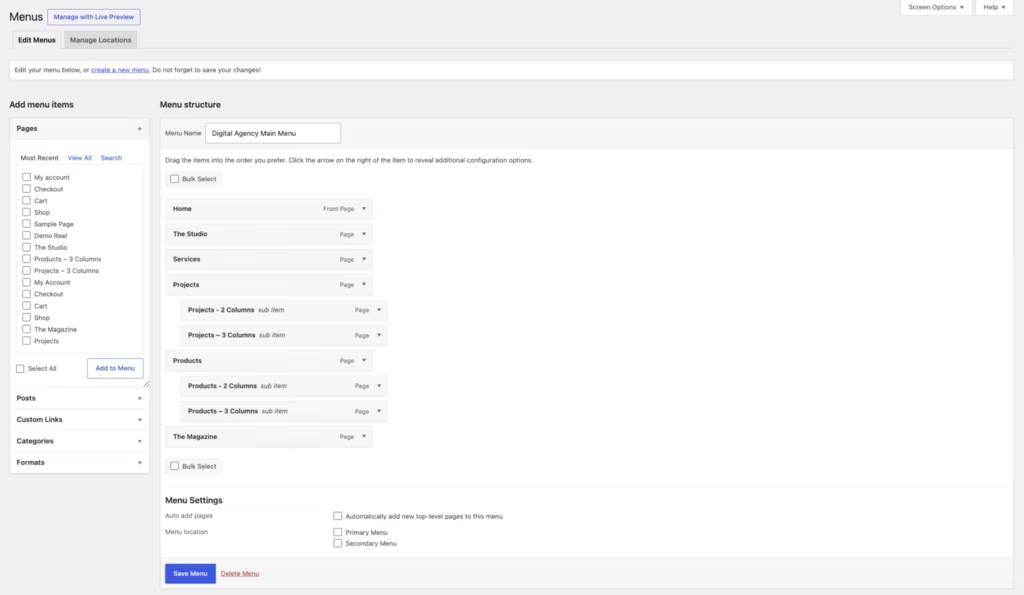
the 30+ pre-built website demos interface in ArcHub — the strongest first-hand evidence this page can carry.


Pre-Built Demo Library and Template Collection

ArcHub ships with more than 30 complete website demos designed specifically for architecture firms, interior design studios, construction companies, and real estate developers. These demos are designed for architecture firms, interior design studios, construction companies, and real estate developers, providing industry-focused starting points for different types of projects.

Beyond the full demos, the theme includes 200+ section templates and 40+ inner page templates. That combination means a designer can either start from a complete site and strip it back, or assemble a custom layout from individual sections without touching a single demo wholesale. The inner page templates cover the supporting pages — about, services, contact, team — that typically consume the most build time on a project site.

The downloaded package extracts to a well-organized structure: archub.zip (main theme), archub-child.zip (child theme), a Plugins folder, a Licensing folder, an Online Documentation PDF, and a changelog.txt file. Setup from a fresh WordPress install completes in approximately two minutes.

Visual Drag-and-Drop Editor

ArcHub is built for Elementor and Elementor Pro, and the visual editing experience is designed around that integration. This means anyone already comfortable with that builder faces no learning curve specific to this theme.

For a studio’s in-house team, that translates to ongoing content updates — swapping a project image, adjusting a headline, reordering sections — without developer involvement. ArcHub includes more than 200 section templates that can be used when building pages with Elementor, giving users additional layout options beyond the pre-built demos.

Responsive and High-Resolution Layout

Every layout in ArcHub is responsive, adapting across desktop, tablet, and mobile viewports. The theme is also high-resolution ready, which matters specifically for architecture and interior design work where large-format project photography is the primary visual asset — images need to render sharply on retina displays without manual optimization per template.

The underlying grid supports four or more columns, giving designers the flexibility to present project portfolios in dense grid formats or more spacious editorial layouts depending on the studio’s aesthetic. Widget-ready areas extend that flexibility to sidebars and footer zones.

WooCommerce and E-Commerce Support

ArcHub supports WooCommerce across versions 5.x through 8.x, covering a wide range of active installations. For architecture and design studios, that opens up practical use cases: selling digital assets, taking deposits for consultations, or running a small product shop alongside a portfolio site — all within the same theme.

ArcHub is compatible with WooCommerce, allowing architecture and interior design websites to add an online store for products, services, or digital downloads.

Multilingual Support via WPML

ArcHub is compatible with WPML, the most widely used multilingual plugin for WordPress. Studios operating across language markets — or agencies building sites for international clients — can manage translated content through WPML’s interface without needing a separate multilingual theme or custom development.

ArcHub is compatible with WPML, allowing multilingual websites to be created using the WPML plugin.

Cross-Browser Compatibility and Framework

The theme is tested across Firefox, Safari, Opera, Chrome, and Edge, covering the browsers that account for the vast majority of professional and consumer web traffic. It is built on Bootstrap 4.x, a well-documented front-end framework that gives developers a predictable grid and component system to work from if customization extends beyond the visual editor.

For studios handing a finished site to a client’s internal team, broad browser coverage reduces the risk of layout inconsistencies surfacing after handoff — a common friction point with niche or less-tested themes.

Installation and Setup

  1. Purchase ArcHub from Themeforest and download the package. Extract the archive — it contains the main theme file (archub.zip), a child theme file (archub-child.zip), a Plugins folder, a Licensing folder, an Online Documentation PDF, and a changelog.txt.
  1. Log in to your WordPress dashboard and navigate to Appearance → Themes → Add New → Upload Theme. Upload archub.zip and activate it. If you plan to customize the theme, upload and activate archub-child.zip instead and use that as your working theme.
  1. Install and activate the companion plugins. ArcHub works with Elementor and Elementor Pro — install and activate Elementor; Elementor Pro is supported for extended functionality. WooCommerce is required if you intend to run an online store. WPML is required for multilingual sites. Install each directly through the WordPress plugin directory or from the Plugins folder included in the downloaded package.
  1. Once the theme and plugins are active, navigate to the theme’s demo import area from the dashboard. Select the demo that best matches your project and import it. Setup from installation to a working demo takes approximately two minutes.
  1. With the demo content in place, use the Elementor editor to swap in your own content — portfolio projects, team members, service pages, and contact details. The 200+ section templates and 40+ inner page templates give you additional building blocks beyond the imported demo.
  1. Review the Online Documentation PDF included in the downloaded package for guidance on theme options, widget areas, and any configuration specific to your chosen demo.

Compatibility and Requirements

Requirement Details
WordPress 4.9.x through 6.8.x
PHP Tested on PHP 8.4
Page Builders Elementor, Elementor Pro
E-commerce WooCommerce 5.x, 6.x, 7.x, 8.x
Multilingual WPML
CSS Framework Bootstrap 4.x
Browsers Chrome, Firefox, Safari, Opera, Edge
Responsive Yes
High Resolution Yes
Widget Ready Yes
Gutenberg Optimized No

ArcHub covers a wide WordPress version range, from 4.9.x up to 6.8.x, making it compatible with both long-standing installations and current deployments. The theme has been tested on PHP 8.4.

WooCommerce compatibility spans versions 5.x through 8.x, covering several release generations. WPML handles multilingual requirements for studios serving international clients. The theme is not Gutenberg-optimized, so users who rely on the block editor for page building should factor that into their workflow planning — the visual editing experience is designed around Elementor.

ArcHub Pricing

ArcHub is a premium theme sold exclusively through Themeforest. There is no free version or trial tier.

Regular License — $59

Covers a single end product. End users of that product cannot be charged for access. This is the standard choice for architecture firms, interior design studios, or freelancers building a site for a single client.

Extended License — $2,900

Also covers one end product, but permits charging end users for access — relevant if the site is a paid membership platform, a subscription-based portfolio service, or a similar monetized product.

Both licenses include six months of support from LiquidThemes. ThemeForest also offers an optional support extension to 12 months. At the time of writing, the product page displays both $41.13 and $17.63 in relation to the support extension, but it does not clearly indicate which is the current purchase price and which, if either, is a promotional or legacy price. Check the ArcHub product page for the latest support pricing before purchasing.

Neither license covers multiple sites. Each additional project requires a separate purchase.

👉 Get ArcHub at the best available price

Alternatives to ArcHub

ArcHub’s niche focus on architecture and interior design sets it apart from the multipurpose themes that dominate the WordPress market, but those broader options are worth considering depending on how much flexibility your project demands.

Product Key Difference Best For Price Tier
ArcHub Purpose-built demo library for architecture and interior design verticals; fast deployment for studios Architecture firms and interior design studios wanting a ready-made, niche-specific site Paid
Avada Widely adopted ThemeForest theme built around its own Fusion Builder; broad multipurpose scope rather than vertical depth Teams wanting a widely adopted, general-purpose theme with a large support community Paid
The7 Deep Elementor and WPBakery integration with extensive design customization across many industries Agencies and freelancers building varied client sites who need maximum layout flexibility Paid
Astra Lightweight, performance-focused freemium theme compatible with all major page builders and a large starter template library Studios on a tighter budget or those prioritizing page speed and builder flexibility Freemium
OceanWP Modular extension system emphasizing speed and extensibility across general business niches Budget-conscious users who want a lean base theme they can extend incrementally Freemium
Flatsome WooCommerce-focused theme built around its own UX Builder; oriented toward e-commerce stores Studios whose primary goal is selling products online rather than showcasing a portfolio Paid

Competitor details reflect publicly available information and may have changed.

If your site is an architecture or interior design portfolio, ArcHub’s curated demo library shortens the build considerably. If you need a theme that works equally well across unrelated industries or client types, one of the multipurpose options above will give you more room to adapt.

Frequently Asked Questions

How many demo sites does ArcHub include?

ArcHub ships with 30+ pre-built website demos, all designed specifically for architecture and interior design verticals. The theme also includes 200+ section templates and 40+ inner page templates, giving you a large library of ready-made layouts to mix and match.

Does ArcHub work with Elementor?

Yes, ArcHub is compatible with both Elementor and Elementor Pro. The theme’s visual editing experience is built around this integration, allowing you to customize layouts without writing any code.

How much does ArcHub cost?

The Regular License is $59 and covers a single site where end users are not charged for access. The Extended License costs $2,900 and is required when end users will be charged — for example, a subscription or paid-access product. Both licenses include six months of support from LiquidThemes.

Is ArcHub compatible with WooCommerce?

ArcHub supports WooCommerce versions 5.x through 8.x, making it possible to add an online store to an architecture or interior design site. This covers use cases such as selling products, services, or digital downloads directly from the site.

Can I use ArcHub on multiple websites?

No — both the Regular License and the Extended License are single-site licenses. A separate license purchase is required for each additional site.

Does ArcHub support WPML for multilingual sites?

Yes, ArcHub includes WPML compatibility, allowing you to build multilingual versions of your site using the WPML plugin. This is particularly useful for architecture firms or studios serving clients across different language markets.

Download & Pricing Options

🔍 Try Before You Buy

ArcHub does not have an official free tier. To evaluate it before purchasing, a GPL-licensed copy is available for sandbox testing purposes only.

👉 Download GPL Evaluation Copy

This is a GPL-licensed redistributed copy for testing only — not an official developer product.


💎 Get ArcHub (Best Available Price)

👉 Check Current Pricing for ArcHub

Pricing and availability may change — use the link above for current rates.

TAGGED:archub – architecture and interior design wordpress themearchub – architecture and interior design wordpress theme 2026archub – architecture and interior design wordpress theme reviewarchub theme reviewarchub workdemo sitesmany demomuch archubWordPress Themework elementor?
Previous Article MediaFlex Theme Review 2026: Best for TV & Streaming Sites?
Next Article Eduma Theme Review 2026: Best WordPress LMS Theme?
FacebookLike
PinterestPin
InstagramFollow
YoutubeSubscribe

Subscribe Now

Subscribe to our newsletter to get our newest articles instantly!

    Most Popular
    SEOPress Pro Review 2026: Features, Pricing and Verdict
    September 21, 2026
    Most WordPress form plugins stop at the point of submission: the entry lands in the database, an email goes out, and everything after that is your problem. This Formidable Forms Pro review looks at a builder that treats submitted data as something you can act on — collecting payments, triggering automated workflows, and publishing entries back to the front end through Views. For anyone who has outgrown a basic contact form and started sketching directories, calculators, or client-facing dashboards, that distinction matters more than field types do. The question is whether an annual license justifies itself for site owners whose forms need to do real work after the submit button. Quick Verdict Formidable Forms suits freelancers, agencies, and business owners building data-driven forms — payment flows, application systems, front-end listings — on WordPress. Anyone who only needs a styled contact form will find the license hard to justify, and the plugin has no use outside WordPress. Pros Views display submitted entry data on the front end, turning forms into simple web applications rather than one-way capture points Payment collection through Stripe, PayPal, Square, and Authorize.net covers most common checkout setups CRM and automation integrations include Salesforce, Zapier, Google Sheets, HubSpot, and Mailchimp Business and Elite licenses cover unlimited sites, including client sites — practical for agencies juggling multiple builds Over 100 form templates give you a starting point instead of a blank canvas Layered spam protection built in via reCAPTCHA, honeypot, and Akismet Pro zip uploads directly through the WordPress plugin uploader with no extraction step Cons User registration is limited to certain plans and requires a separate add-on rather than working out of the box Single-site and three-site limits on Basic and Plus push multi-site owners toward the pricier Business or Elite tiers 👉 See Formidable Forms pricing Core Features The formidable-pro-6.34.zip file installs directly in WordPress via Plugins → Add New Plugin → Upload Plugin, without extracting it first — a small detail, but one that saves a step for anyone used to unzipping archives before upload. Views: Displaying Submitted Entries on the Front End Views are the feature that separates Formidable Forms from the average contact form plugin. Instead of entry data sitting in the WordPress admin waiting for someone to export it, Views pull submitted entries back out and render them on the front end — as directories, listings, tables, profile pages, or whatever layout the data suits. That changes what a form is for. A submission stops being a message you reply to and becomes content that populates a page. Job boards, member directories, event calendars, review listings, and internal dashboards all become achievable without a separate directory plugin or custom post type work. For anyone considering the Pro license specifically, this is usually the reason. Views are what make the "front-end web applications" claim more than marketing language. Form Builder for Simple Forms and Full Applications The builder handles the ordinary case — a contact form, a quote request, a newsletter signup — and then keeps going. The same interface builds multi-step forms and calculation-driven applications, so you are not learning a second tool when a project grows past a name-and-email field. The practical benefit is consistency across a portfolio. A freelancer building a five-field contact form on one site and a mortgage calculator on another works inside the same builder both times, which shortens the second build considerably. Payment Collection Payments run through Stripe, PayPal, Square, and Authorize.net. Having four processors available matters more than it sounds: merchant account availability varies by country and by business type, and being locked to a single gateway is a common reason form plugins get replaced mid-project. This covers the transactions that do not belong in a full store — donations, deposits, booking fees, application charges, invoice payments. Rather than installing WooCommerce to take a single fee, you attach payment collection to a form you were building anyway. A WooCommerce integration is available separately for sites that do run a store. Workflow Automation Automation ties what happens after submission to conditions you set, so form data triggers actions instead of just landing in a database table. Combined with Views, it is the second half of the application-building story — data comes in, actions fire, results display. For a business owner, this is the difference between checking an inbox and having submissions route themselves. Approval steps, conditional notifications, and follow-up actions run without anyone opening the WordPress dashboard. Integrations With CRMs, Marketing Tools, and Automation Platforms The integration list covers Salesforce, HubSpot, Mailchimp, Zapier, Google Sheets, ChatGPT, and Webhooks alongside the payment gateways, plus WooCommerce and ACF on the WordPress side. Two of those deserve attention. Zapier and Webhooks together mean that anything not on the native list is still reachable, and Webhooks in particular gives developers a direct route into custom endpoints. Google Sheets suits teams who want submissions in a spreadsheet their non-technical colleagues already use, without granting WordPress admin access. 100+ Form Templates The template library ships with over 100 prebuilt forms. For agencies handling repetitive client requests — contact, quote, registration, application, feedback — starting from a template and editing fields is faster than building from an empty canvas each time. Templates also serve as a reference for how the builder handles more complex structures, which helps when you are moving from simple forms toward calculation or multi-page setups. Layered Spam Protection Three spam defenses are built into the plugin's settings: reCAPTCHA, a honeypot field, and Akismet. They work at different points — the honeypot catches naive bots silently, reCAPTCHA challenges suspicious sessions, and Akismet checks submission content against a shared spam database. Because all three are configured inside Formidable Forms rather than bolted on through separate plugins, you can layer them according to how aggressive a given form needs to be. A newsletter signup and a public job application do not need the same level of friction. User Registration Forms can create WordPress user accounts, which turns a signup form into the front door of a membership area, client portal, or community site. Registration is not part of the base install — it depends on the user registration add-on and is limited to certain plans, so confirm plan eligibility before committing to a build that relies on it. Paired with Views, registration supports a common pattern: users sign up, submit entries, and see their own submissions displayed back to them on the front end. Installation and Setup Setup is quick. Tested on WordPress 6.5 with PHP 8.4, installation and basic configuration took about two minutes from upload to a working form. Install the free Formidable Forms plugin first. The free core plugin is distributed through the WordPress.org plugin directory. Search for it under Plugins → Add New Plugin, install it, and activate it. The Pro plugin is an extension, not a replacement — the free core plugin must remain installed and active for Pro to function. Deactivating it will break the Pro features. Purchase a Pro license. Four tiers are sold: Basic, Plus, Business, and Elite. Download the Pro plugin ZIP from your account after purchase. Upload the Pro ZIP through WordPress. Go to Plugins → Add New Plugin → Upload Plugin, choose the ZIP file, and install it. The archive installs directly — there is no need to extract it or dig for a nested plugin folder inside it first. Activate the Pro plugin. Both plugins now appear in your plugin list, and the Pro features become available inside the Formidable Forms admin screens. Build your first form, starting from a template rather than a blank canvas. Turn on spam protection. reCAPTCHA, honeypot, and Akismet are all supported and configured through the plugin's settings. Connect the services you need. Payment processors and third-party tools are set up per form or through the global settings, depending on the integration. Add the user registration add-on if your plan includes it. The vendor maintains a Docs & Support area and a community resource for anything beyond the basics. Compatibility and Requirements Requirement Detail WordPress version 6.3 or higher PHP version 7.4 or higher License GPL The vendor is blunt about the platform requirement: "Formidable Forms is a WordPress Plugin. In order to use Formidable Forms, you must have a WordPress site. That's all." There is no standalone, hosted, or non-WordPress version — if your site runs on Squarespace, Webflow, or a static generator, this is not the tool for you. For a live, public-facing site, pair a currently supported PHP version with the current stable WordPress release rather than sitting at the stated minimums. Unsupported PHP branches stop receiving security patches, and a form plugin handling payments and personal data is the last place to accept that risk. On the integration side, the plugin connects with Stripe, PayPal, Square, and Authorize.net for payments, plus Salesforce, HubSpot, Mailchimp, Zapier, ChatGPT, Google Sheets, Webhooks, WooCommerce, and ACF. Formidable Forms Pricing Formidable Forms runs on a freemium model. The free core plugin, distributed through the WordPress.org plugin directory and often referred to as Formidable Forms Lite, is a drag-and-drop form builder used on hundreds of thousands of active sites. It handles standard form building on its own, and it also acts as the foundation for the paid product. The Pro version is sold as an annual license across four tiers. Plan Price Sites Basic $79/year 1 site Plus $199/year Up to 3 sites Business $399/year Unlimited sites, including client sites Elite $599/year Unlimited sites, including client sites All four tiers are currently listed at 50% off those regular rates — Basic at $39.50/year, Plus at $99.50/year, Business at $199.50/year, and Elite at $299.50/year. Discounting at this depth is a familiar pattern in the WordPress form builder market, so treat the promotional figure as the price you are likely to see rather than the price the plugin is nominally worth. Paid plans are GPL licensed and include one year of updates and support. A 14-day money-back guarantee applies to purchases. For agencies and freelancers, the Business and Elite tiers are the ones worth weighing. Both cover unlimited sites, client sites included, which removes the per-project license math that eats into small builds. Alternatively, a license can be purchased per client site if you would rather bill each project separately. Formidable Forms also runs an affiliate program paying 20% commission. Feature availability differs by tier. Check the current plan comparison at formidableforms.com before buying so the tier you choose covers the integrations and add-ons your build actually needs. 👉 Get Formidable Forms at the best available price Alternatives to Formidable Forms Formidable Forms sits at the heavier end of the WordPress form builder market, where the job extends past capturing a message into payments, automation, and displaying submitted entries on the front end through Views. The alternatives below are the names most site owners weigh against it, and they differ mainly in how far past basic form capture they go. Product Key Difference Best For Price Tier Formidable Forms Views display submitted entry data on the front end, alongside payments, workflow automation, and unlimited-site licensing on the Business and Elite tiers Freelancers and agencies building data-driven forms and front-end applications across multiple sites Freemium, with paid annual Pro licenses WPForms Beginner-oriented drag-and-drop builder with a template-first onboarding flow Site owners who want conventional contact, survey, and order forms with minimal setup Freemium, with paid annual licenses Gravity Forms Long-established developer-focused builder with a large third-party add-on ecosystem Developers who want extensive hooks and a wide catalog of extensions Paid, subscription-based Fluent Forms Positioned around a lightweight footprint and fast form rendering Sites where keeping plugin overhead low is a priority Freemium, with paid licenses Ninja Forms Modular architecture where features are added as individual extensions Users who prefer to pay only for the specific functions they need Freemium, with paid extensions Contact Form 7 Minimal, markup-driven form handling with no built-in visual builder Simple contact forms on sites that need nothing more Free Competitor data is sourced from publicly available information as of 2026 and may have changed. The right pick comes down to what you are actually building. A single contact form does not justify an annual license, but if you need front-end entry display, payment gateways, and CRM handoff on several client sites, the comparison narrows quickly. Frequently Asked Questions Is Formidable Forms free or do you need the Pro version? A free version exists and is distributed through the WordPress.org plugin directory as a drag-and-drop form builder. The Pro version is sold as a paid annual license and adds the features covered above, including Views, payment collection, and the wider integration set. Does Formidable Forms require the free plugin to be installed? Yes. The free Formidable Forms core plugin must remain installed and active for the Pro plugin to function — Pro runs as an extension of the core plugin rather than a standalone replacement. How much does Formidable Forms cost per year? There are four annual tiers: Basic at $79/year, Plus at $199/year, Business at $399/year, and Elite at $599/year. All four are currently listed at 50% off those regular prices, so the promotional figures are $39.50, $99.50, $199.50, and $299.50 respectively. How many sites can I use one Formidable Forms license on? Basic covers a single website and Plus covers up to three sites. Business and Elite licenses can be used on unlimited sites, including client sites, or a license can instead be purchased per client site. What are Formidable Forms Views used for? Views display submitted entry data on the front end of your site, so form submissions become readable content rather than data locked in the admin area. That is what allows the plugin to power directories, listings, and simple front-end web applications instead of just capturing and storing entries. Can Formidable Forms collect payments with Stripe or PayPal? Yes. Payment collection is a core capability, with integrations for Stripe, PayPal, Square, and Authorize.net, alongside WooCommerce for store-based workflows. What are the WordPress and PHP requirements for Formidable Forms? Recent versions require WordPress 6.3 or higher and PHP 7.4 or higher. Beyond that, a WordPress site is the only requirement — the plugin does not work on non-WordPress platforms. We installed it on WordPress 6.5 with PHP 8.4 without issues. Does Formidable Forms offer a refund or money-back guarantee? Yes, a 14-day money-back guarantee applies to purchases. That gives you a short window to test the Pro feature set on a real site before the sale becomes final. Is Formidable Forms GPL licensed? Yes, the Pro plugin is distributed under the GNU General Public License. Paid plans include one year of updates and support, which means continued access to updates depends on renewing the license. Download & Pricing Options 🆓 Free Version 👉 Download the Free Version of Formidable Forms 💎 Get Formidable Forms (Best Available Price) 👉 Check Current Pricing for Formidable Forms Pricing and availability may change — use the link above for current rates. Buying Formidable Forms Pro outright is not the only route. See our best GPL site for WordPress comparison for how ten GPL vendors differ on file integrity, update speed and licence keys.

    Formidable Forms Pro Review 2026: Features, Pricing, Verdict
    September 21, 2026
    UpdraftPlus Premium Review 2026: Is the Upgrade Worth It?
    September 21, 2026
    FluentCRM Pro Review 2026: Features, Pricing and Verdict
    September 21, 2026
    PixelYourSite PRO Review 2026: Is This Tracking Plugin Worth It?
    September 17, 2026

    You Might Also Like

    Web GuidesWordPress Themes

    Real Soccer Sport Clubs WordPress Theme Review for 2026

    13 Min Read
    Web GuidesWordPress Themes

    JupiterX Theme Review 2026: Is It Worth Buying?

    17 Min Read
    WordPress ThemesWeb Guides

    Bacola Theme Review 2026: Best for Grocery Stores?

    16 Min Read
    Web GuidesWordPress Themes

    Cornerstone Website Builder Review 2026: Is It Worth It?

    14 Min Read

    Always Stay Up to Date

    Subscribe to our newsletter to get our newest articles instantly!

      blog-log blog-log

      We share tips, tricks, and guides to help you build better WordPress websites and improve online success.

      Free For You!

      • Elementor Pro
      • AvadaNew
      • JNews
      • Premium Plugins

      Quick Links

      • GPL Explained
      • Tips & Tricks
      • Tutorials
      • Web Guides

      Unlock the Unexpected!

      Think PureGPL is just another GPL site? Think again. 👀
      Surprise Me
      Welcome Back!

      Sign in to your account

      Username or Email Address
      Password

      Lost your password?